

Square Ducting: Rectangular Metal Duct Solutions for HVAC Systems
Square and Rectangular Ducting for Commercial HVAC Projects
Source square ducting and rectangular ducting for commercial and industrial HVAC projects with All Insulation & HVAC Supplies (AIandHS). With 20 years of industry experience, Australia-wide supply and lead times of one week or less, we help HVAC contractors, builders and mechanical services professionals source ducting solutions to meet their project requirements.
Whether you need straight duct sections, fittings or a square-to-round duct transition, our team can assist with product enquiries and specifications. From office fit-outs to large commercial ventilation systems, we understand the importance of accurate dimensions, reliable supply and ductwork that integrates with the wider HVAC system.
Explore Our Ducting Range
From the manufacturing to transport and installation, trust our experienced team to provide you with the P3 ducts, materials and accessories required for your ventilation and insulation projects.
Square & Rectangular Ducting
Metal ducting solutions for commercial ventilation and air conditioning systems.
Spiral Ducting
Round spiral duct systems for HVAC, ventilation and extraction applications.
P3 Ducting
Pre-insulated ducting solutions for suitable commercial HVAC applications.
Duct Fittings & Transitions
Explore connection requirements for elbows, offsets, branches and duct transitions.
Ordering Square Ducting
1. Send Us Your Specifications
Share your project drawings, duct dimensions, material requirements and quantities. Include any relevant information about fittings, insulation and installation conditions.
2. Confirm Your Requirements
Our team will review your enquiry and discuss suitable product options, specifications and availability.
3. Arrange Supply
Once your requirements are confirmed, we’ll provide a quote and supply information to help you plan your installation.
What Is Square Ducting?
Square ducting is a rigid ductwork system used to distribute air through commercial and industrial buildings. It is typically manufactured from galvanised sheet metal, formed into a square or rectangular cross-section rather than a round profile.
Although the terms square ducting and rectangular ducting are often used interchangeably, there is a technical difference. Square ducts have four equal sides, while rectangular ducts have different width and height dimensions.
Both shapes are commonly used in heating, ventilation and air conditioning systems, particularly where space restrictions make round ductwork less practical. For example, a wide, shallow rectangular duct may fit within a ceiling cavity where a round duct of equivalent airflow capacity would require too much vertical clearance.
Metal duct sections can be manufactured using folded sheet metal and joined along longitudinal seams. Depending on the construction method, additional reinforcement, such as cross-breaking, may be required to improve rigidity.
Ductwork may be installed as a single-wall system or combined with suitable insulation. For projects requiring pre-insulated panel construction, explore our P3 Ducting range.

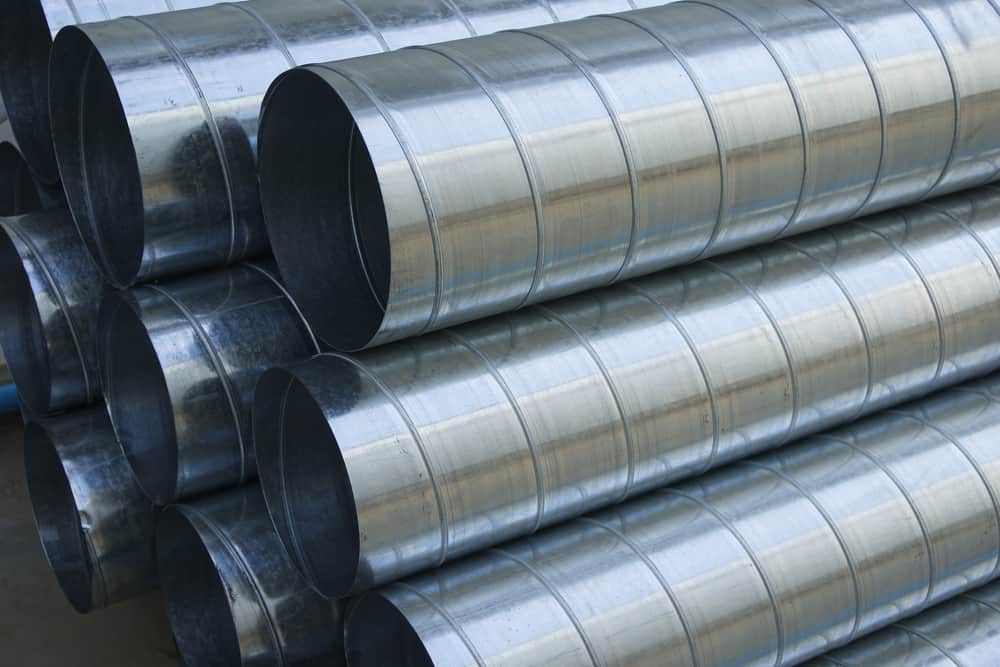
Square Ducting Specifications
The dimensions and construction of rectangular ductwork depend on the intended application, airflow requirements and project drawings. The following table outlines common industry specifications. Actual product availability and manufacturing options should be confirmed when requesting a quote.
Specification | Typical Details |
Duct shape | Square or rectangular |
Material | Galvanised sheet metal |
Material thickness | Common industry gauges range from approximately 0.55 mm to 1.2 mm |
Standard lengths | Commonly around 1,200–1,220 mm, depending on the manufacturer |
Dimensions | Selected to suit project drawings and airflow requirements |
Wall configuration | Single-wall or insulated configurations, depending on system requirements |
Connections | Suitable flanges, joints, fittings and transitions |
Applications | Commercial air conditioning, ventilation and suitable extraction systems |
Duct size, sheet metal thickness, joint construction and reinforcement must be selected according to the operating pressure, dimensions and relevant construction standards. For projects with specific performance requirements, provide your mechanical drawings and specifications when enquiring.
Why Choose Square or Rectangular Ducting?
Suitable for Restricted Ceiling Spaces
One of the main advantages of rectangular ducting is its ability to accommodate shallow ceiling cavities and bulkheads. A wider, flatter profile can help contractors work around structural elements and other building services.
Flexible Ductwork Configurations
Square and rectangular ducts can be incorporated into systems with straight sections, elbows, offsets, branches and transition fittings. This allows ductwork layouts to accommodate changes in direction, size and available space.
Commonly Used in Commercial Buildings
From office fit-outs to retail centres and industrial facilities, rectangular duct systems are used to distribute supply, return and exhaust air through a range of building environments.
Multiple Construction Options
Galvanised sheet metal is commonly used for rigid rectangular ducts. Depending on the application, insulation can also be incorporated to help manage heat transfer and condensation.
Compatibility With Round Duct Systems
Square and rectangular ducts can connect to round or spiral ductwork using appropriately designed transition fittings. This allows different duct shapes to be incorporated within the same HVAC system.
Designed to Meet Project Specifications
Duct dimensions, material thickness, reinforcement and connection details can be specified according to the mechanical design. This helps ensure the selected ductwork meets the intended installation and performance requirements.
Square to Round Duct Transitions
Commercial HVAC systems often incorporate different duct shapes to accommodate building layouts, equipment connections and airflow requirements. A square to round duct transition is a fitting that connects a square or rectangular duct section to round ductwork. It allows air to move between the two shapes without requiring the entire system to use the same duct profile.
A rectangular to round duct transition is commonly required when:
- Connecting rectangular ductwork to round spiral duct sections.
- Moving from a shallow ceiling bulkhead into a round duct riser.
- Connecting ductwork to fans, air conditioning units or equipment with circular spigots.
- Adapting duct dimensions where the system layout changes.
Transition fittings may be concentric, eccentric or offset, depending on how the connected ducts need to align. For example, an offset transition may be suitable where one side of the duct must remain aligned with a ceiling or wall while the other side changes shape.
When selecting a transition, consider the duct dimensions, connection type, available space and airflow requirements. Gradual transitions can help minimise turbulence and unnecessary pressure losses.
Explore our Spiral Ducting solutions for compatible round ductwork applications.

Square and Rectangular Ducting vs Spiral Ducting
Both rectangular and round spiral ducting are commonly used in HVAC systems, but their shapes offer different advantages. The most suitable option depends on the building layout, available installation space and system performance requirements.
Factor | Square / Rectangular Ducting | Spiral Ducting |
Shape | Square or rectangular cross-section | Round cross-section |
Best suited to | Restricted ceiling spaces and bulkheads | Longer duct runs with suitable clearance |
Space requirements | Can use a wider, shallower profile | Requires clearance for its circular diameter |
Airflow | Aspect ratio and fittings influence pressure loss | Generally offers lower friction losses for comparable airflow area |
Common applications | Commercial fit-outs, ceiling voids and plant rooms | Commercial ventilation, extraction and exposed duct runs |
Connections | Flanges, joints and transition fittings | Round couplings and compatible fittings |
Round ductwork generally offers favourable airflow efficiency because its shape provides a lower perimeter relative to its cross-sectional area. However, rectangular ducting can be more practical where ceiling height is limited or where ductwork needs to fit around other services. For HVAC contractors and engineers, the decision should be based on the mechanical design rather than duct shape alone.
Common Applications for Square Ducting
Square ducting is used across a range of commercial and industrial environments where efficient air distribution and practical installation are required.
Commercial and Retail Fit-Outs
Rectangular ducts can be installed within ceiling cavities and bulkheads to distribute conditioned air throughout retail stores, shopping centres and other commercial spaces.
Office Buildings
Shallow duct profiles can help accommodate ventilation and air conditioning systems above suspended ceilings, particularly where multiple building services share the same space.
Warehouses and Industrial Facilities
Rectangular duct systems may be used for supply air, return air and general ventilation, depending on the building’s mechanical requirements.
Plant Rooms
Square and rectangular ducts can connect air handling equipment to distribution networks, using elbows, offsets and transitions where required.
Kitchen Exhaust and Extraction Systems
Suitable rectangular metal ductwork may be incorporated into commercial exhaust systems, provided the materials, construction and installation meet the applicable requirements for the specific application.
Australian Standards for Square and Rectangular Ductwork
Commercial HVAC ductwork must be designed and installed according to applicable Australian Standards, regulatory requirements and project specifications. AS 4254.2 – Ductwork for Air-Handling Systems in Buildings is a key standard covering the construction and installation of rigid ductwork.
Depending on the system, relevant requirements may include:
- Duct material thickness and construction.
- Joint and seam sealing.
- Air leakage performance.
- Reinforcement and support requirements.
- Installation and connection methods.
For galvanised sheet metal, AS/NZS 1397 may also be relevant to the material specification.
The appropriate construction method and compliance requirements depend on the duct dimensions, operating pressure, application and project documentation. HVAC contractors and engineers should confirm the applicable standards and specifications before selecting or ordering ductwork.


Why Choose All Insulation & HVAC Supplies?
At All Insulation & HVAC Supplies, we understand that HVAC contractors need more than a broad product range. They need accurate product information, dependable supply and materials suited to their project requirements.
With 20 years of industry experience, we support contractors and mechanical services professionals working across commercial and industrial HVAC applications.
20 Years of Industry Experience
Our experience in HVAC insulation and ducting supplies helps us understand the practical requirements of commercial installations.
Australia-Wide Supply
We supply HVAC products to contractors and businesses across Australia, supporting projects in a range of locations.
Lead Times of One Week or Less
Our short lead times help contractors plan procurement and keep projects moving, subject to product specifications and availability.
Comprehensive HVAC Product Range
Alongside square and rectangular ducting, explore our spiral ducting, P3 ducting and HVAC insulation products. Whether you’re preparing a quotation, reviewing mechanical drawings or sourcing materials for an upcoming installation, contact our team to discuss your requirements.
Get a Quote for
Square Ducting
Need square ducting, rectangular ductwork or transition fittings for an upcoming HVAC project?
Contact All Insulation & HVAC Supplies to discuss your specifications, product requirements and supply options. Send us your drawings, dimensions and quantities, and our team can help you take the next step.
Call 1300 180 926 or request a quote online.
Or call us on 1300 887 260